 Skip to content
For years, the end-user computing conversation has focused heavily on the cloud side of the equation. Azure Virtual Desktop. Windows 365. DaaS. Image management. Identity. Security layers. Cost optimization.
But NerdioCon 2026 made something increasingly obvious across the Microsoft EUC ecosystem:
The endpoint is no longer an afterthought.
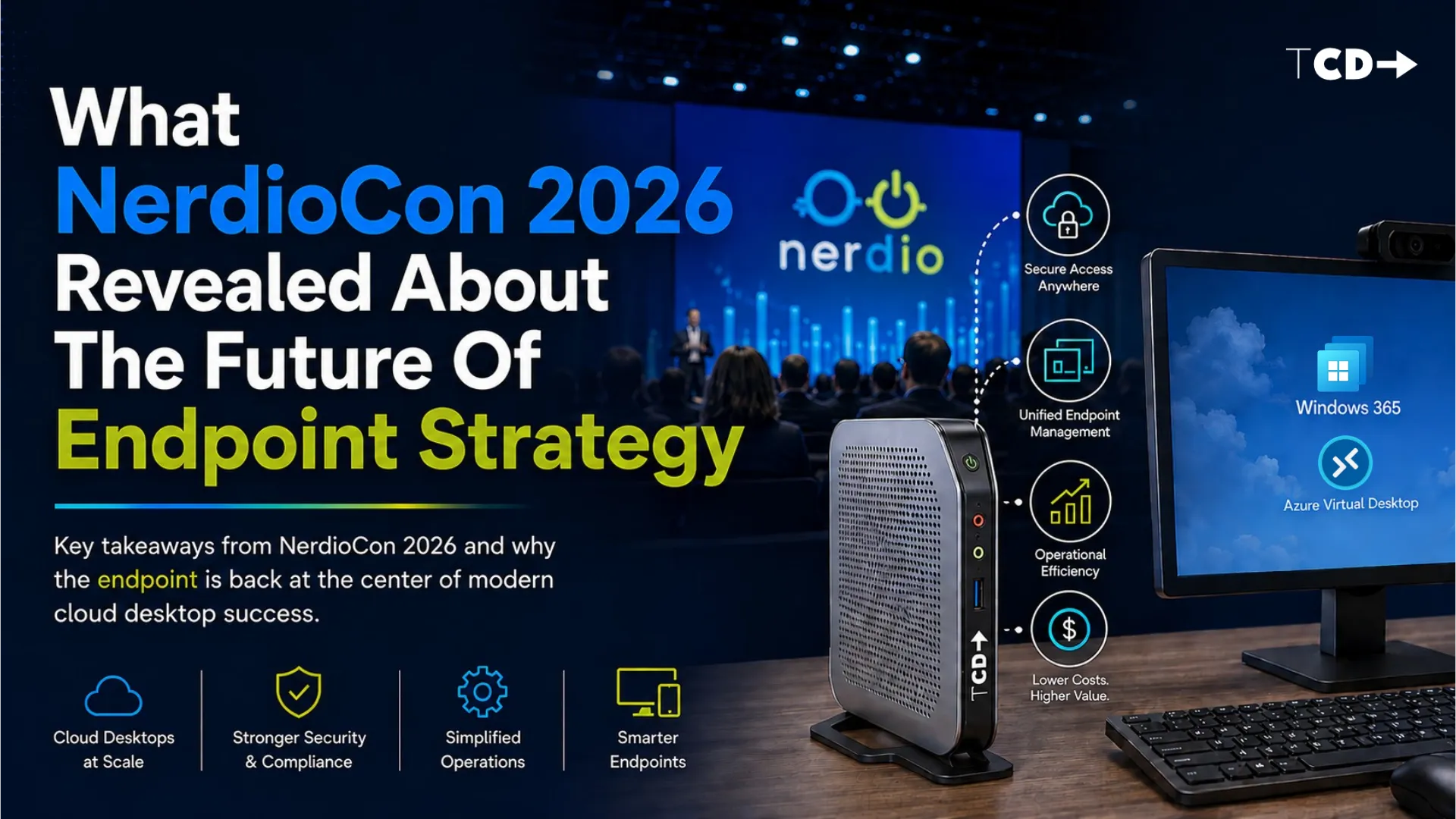
The event, hosted by Nerdio, brought together Microsoft professionals, MSPs, enterprise IT teams, architects, and EUC vendors to discuss how organizations are operationalizing cloud desktops at scale. And while the sessions heavily covered Windows 365, Azure Virtual Desktop (AVD), Microsoft Intune, automation, AI, and cloud management, the underlying message throughout the conference was much broader.
Modern cloud desktop environments still depend on a strong endpoint strategy.
NerdioCon 2026 Was Not About “Future” Vision
One thing stood out almost immediately at NerdioCon 2026: The industry is past the “cloud desktops are coming” phase. That part is over.
The conversations happening throughout the event felt much more operational and, honestly, much more urgent. IT teams are now trying to figure out how to scale Windows 365 and Azure Virtual Desktop environments without creating new management headaches, security gaps, or runaway Azure costs.
The official agenda clearly reflected that shift. Sessions focused heavily on real deployment and operational topics, including Windows 365 rollout strategies, Intune governance, hybrid AVD architecture, Citrix migration planning, endpoint security, automation, and performance optimization.
Nerdio described the goal as helping organizations “reduce IT complexity and costs.”
That wording matters because it captures where the market really is right now. This is no longer about testing cloud desktops in a pilot environment. Organizations are actively trying to operationalize them at scale. And that is exactly where the conversation at the endpoint suddenly becomes impossible to ignore.
Why Endpoint Strategy Quietly Became One Of The Most Important Themes
At first glance, NerdioCon looked like a cloud infrastructure conference. But underneath nearly every major discussion was the same reality: Users still need reliable devices. That may sound obvious, but it is becoming one of the biggest operational pain points in modern EUC.
Many organizations have spent the past few years focusing almost entirely on the cloud side of the equation. Now they are discovering something frustrating. Even a well-designed AVD or Windows 365 environment can feel messy if the endpoint layer is inconsistent.
Aging laptops. Unmanaged devices. Different hardware generations. Peripheral issues. Poor Wi-Fi performance. Bloated local operating systems.
All of those problems still follow the user into the cloud desktop experience. That realization quietly became one of the event’s biggest themes. The desktop may now live in Azure, but the user experience still begins at the endpoint.
That is why endpoint standardization, thin clients, centralized management, secure operating systems, and Intune-driven governance are suddenly back in the spotlight.
Microsoft Intune Took A Much Larger Role
One of the clearest signals from NerdioCon 2026 was the centrality of Microsoft Intune to modern EUC architecture. Not long ago, many IT teams still viewed Intune as somewhat separate from traditional VDI strategy. That wall is disappearing fast.
At NerdioCon, Intune felt deeply woven into the broader cloud desktop conversation. That makes sense when you think about where the industry is heading. Organizations want fewer moving parts. They want unified policy management, cloud-native provisioning, stronger compliance visibility, simplified device onboarding, and tighter security controls across both users and endpoints.
Nerdio itself leaned heavily into that direction with updates to Nerdio Manager for Enterprise 8.0, expanding Intune policy management and operational visibility across Windows 365, Azure Virtual Desktop, and endpoint environments.
That shift says a lot about where EUC is heading next. The future stack is increasingly becoming cloud-managed, from the desktop session down to the physical device itself.
Nerdio Compass Highlighted The Real Complexity Behind VDI Migration
Another major announcement at the event was the launch of Nerdio Compass.
Nerdio described Compass as a discovery and assessment platform designed to help organizations evaluate existing VDI environments before migrating toward Windows Cloud environments. The initial focus includes Citrix environment analysis, with future support planned for additional platforms.
Nerdio said the platform helps organizations “assess and plan their modernization journey to Windows Cloud.”
That statement reflects a major reality across enterprise IT.
Most VDI migrations are no longer blocked by infrastructure availability. They are blocked by operational complexity.
Organizations now need a much deeper understanding of user behavior, application dependencies, endpoint readiness, hardware consistency, peripheral requirements, authentication workflows, network performance, and compliance constraints before large-scale migrations can succeed.
That last point is critical. Endpoint readiness is increasingly tied directly to migration success. An organization may successfully design Azure infrastructure while still struggling operationally if the endpoint layer remains fragmented.
Hybrid AVD And Cloud Flexibility Continue To Gain Attention
Another recurring theme throughout NerdioCon 2026 was Hybrid AVD. This matters because many organizations are not fully adopting a single deployment model.
Instead, enterprises are increasingly balancing cloud desktops, on-premises infrastructure, edge environments, regulated workloads, remote users, branch offices, and hybrid identity architectures. That operational reality changes how endpoint devices are evaluated.
The endpoint is no longer simply a Windows PC running local applications. It increasingly serves as a secure access layer across multiple environments. This is one reason thin clients and purpose-built cloud endpoints remain highly relevant despite ongoing predictions of their decline.
In many organizations, cloud migration actually strengthens the case for dedicated endpoint hardware. Organizations exploring hybrid cloud desktop strategies may also want to review Hybrid AVD endpoint optimization strategies, as endpoint consistency becomes increasingly important in mixed cloud and on-prem environments.
Thin Clients And Secure Endpoints Quietly Fit The Direction Of The Market
One of the more interesting takeaways from NerdioCon 2026 was how naturally the modern thin client strategy aligns with the direction the market is moving.
Organizations are under pressure from every angle right now: Security teams want tighter control. IT teams want fewer support tickets. Finance teams want a longer device lifecycle. Users want fast and predictable access. And cloud teams want endpoint consistency because inconsistent hardware creates operational noise very quickly.
That combination is pushing many organizations toward simpler, more purpose-built endpoint models. This is especially true for companies heavily invested in Azure Virtual Desktop, Windows 365, Citrix, Omnissa Horizon, or browser-based SaaS workflows.
Instead of treating every device like a fully loaded traditional PC, many IT teams are starting to rethink the role of the endpoint entirely. In some environments, the endpoint is becoming more like a secure-access layer for the cloud desktop. That shift is another reason thin clients and secure endpoint operating systems remain relevant despite years of predictions that they would disappear.
The Vendor Ecosystem Also Reflected The Shift
The broader vendor presence around NerdioCon also reflected how much endpoint strategy now intersects with cloud desktop strategy.
Endpoint vendors increasingly positioned themselves around AVD compatibility, Windows 365 readiness, centralized management, secure operating systems, peripheral support, simplified deployment, and cloud-first workflows.
That is not accidental. As organizations modernize EUC infrastructure, they are increasingly looking for endpoint hardware that complements cloud management rather than complicates it.
The endpoint market itself is evolving around Microsoft cloud ecosystems.
AI Was Present, But Operations Still Dominated The Conversation
Like nearly every major IT conference in 2026, AI appeared throughout the event. But what stood out at NerdioCon was that operational efficiency remained the dominant theme.
The conversations centered less on theoretical AI transformation and more on practical IT administration, including reducing management overhead, improving visibility, simplifying deployments, automating repetitive tasks, enhancing reporting, controlling Azure spend, and streamlining endpoint governance.
That focus reflects where most enterprise IT teams actually are today. Organizations are still trying to stabilize and modernize their environments before they radically reinvent them.
Why This Matters For Endpoint Strategy
One of the biggest misconceptions in modern EUC is the idea that cloud desktops somehow reduce the importance of endpoint decisions.
If anything, NerdioCon 2026 showed the opposite.
As infrastructure becomes more centralized, endpoint consistency becomes even more valuable. That changes the entire way organizations evaluate devices.
The conversation is no longer just about raw specs or buying the most powerful laptop possible.
IT teams are increasingly asking more operational questions:
- How do we simplify management?
- How do we reduce endpoint troubleshooting?
- How do we standardize remote access?
- How do we improve security posture without increasing complexity?
- How do we lower long-term endpoint costs?
Those questions are suddenly becoming urgent because organizations are no longer experimenting with cloud desktops. They are building real production environments around them. And that means the endpoint can no longer be treated like a secondary decision. And NerdioCon 2026 showed they are becoming central to the EUC conversation again.
For organizations reevaluating their Citrix strategy alongside Windows 365 and AVD planning, why thin client endpoints matter more than ever has also become a much bigger operational discussion across enterprise IT.
Looking Ahead To NerdioCon 2027
One thing feels increasingly certain after NerdioCon 2026: The conversation at the endpoint is only going to grow from here.
As Windows 365, Azure Virtual Desktop, Intune, and hybrid cloud environments continue evolving, organizations are realizing that endpoint consistency, security, and manageability play a much larger role in long-term EUC success than many initially expected.
That transition will likely become even more visible heading into next year’s event. And, given the momentum surrounding this year’s discussions, many organizations across the EUC space will be watching future NerdioCon updates very closely heading into NerdioCon 2027.
The Endpoint May Be Becoming More Important Than Ever
NerdioCon 2026 was officially centered around Azure Virtual Desktop, Windows 365, Intune, automation, AI, and cloud operations.
But underneath those discussions was a broader industry shift. Modern EUC environments are increasingly cloud-managed, policy-driven, security-focused, and endpoint-aware.
The desktop may be hosted in Azure. But user experience still starts at the device.
Organizations planning Windows 365 deployments, Azure Virtual Desktop rollouts, Citrix migrations, or hybrid cloud desktop environments should not treat endpoint strategy as a secondary decision. Because the endpoint is no longer just the hardware sitting on the desk. It has become a core part of the cloud desktop architecture itself.
For organizations looking to simplify endpoint management, improve endpoint consistency, or better align hardware strategy with modern cloud desktop environments, schedule a conversation with an EUC endpoint specialist to explore what a modern endpoint strategy could look like in your environment.