 Skip to content

On September 1st, 2026, Citrix completed its acquisition of Numecent, the company behind Cloudpaging and Cloudpager. The announcement is important for organizations managing complex Windows application estates, but it also raises a natural question for Citrix customers using Linux-based thin clients:
Does this change anything at the endpoint?
The short answer is that it does not immediately change how Linux thin clients operate. Numecent’s technology is focused primarily on packaging and delivering Windows applications to Windows environments. However, the acquisition could strengthen the overall case for secure Linux-based endpoints by making the Windows application environment behind them easier to manage.
Another important piece of context: Citrix already owns a Linux-based endpoint operating system. Citrix acquired Unicon GmbH in January 2025, bringing the eLux endpoint OS and Scout management platform into the Citrix portfolio. The current product is known as UniconOS (formerly eLux), with UniconOS Management (formerly Scout) providing centralized endpoint administration.
This means Citrix now controls more of the workspace stack—from the Linux endpoint and its management platform through the HDX connection and Windows application-delivery layer.
What Did Citrix Acquire?
Numecent provides two complementary technologies:
- Cloudpaging packages Windows applications into isolated containers. Applications can then be streamed on demand without being permanently installed in the underlying Windows image.
- Cloudpager provides centralized provisioning, updating, rollback, removal, license control and usage reporting for those application containers.
Citrix says the acquisition will expand its application-delivery capabilities across virtual and physical Windows environments. According to Citrix’s Cloudpaging documentation, the App Packages Delivery Component on the VDA works with the Numecent Cloudpaging Player to stream and manage applications within the Windows session.
Instead of incorporating every application into a Citrix golden image, administrators can maintain a cleaner Windows base image and deliver applications separately according to user requirements.
Does Cloudpaging Run Windows Applications on Linux Thin Clients?
No—not based on the technology available today.
Cloudpaging applications execute within a supported Windows environment. That environment might be:
- A Citrix Virtual Apps and Desktops session host
- A Citrix DaaS virtual desktop
- A Windows 365 or Azure Virtual Desktop environment
- A physical Windows endpoint
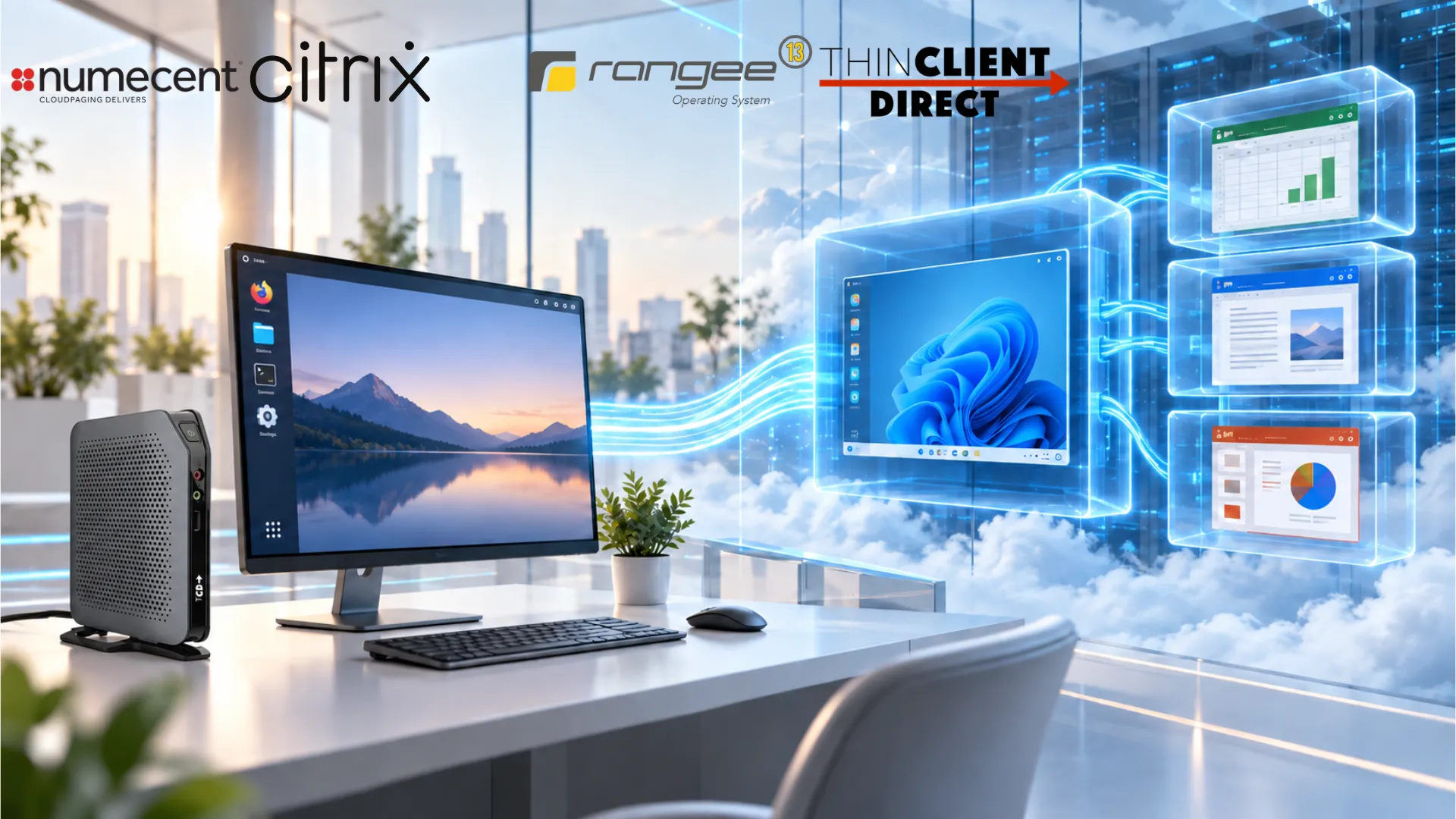
A Linux thin client remains the secure access endpoint. It runs Citrix Workspace App for Linux, establishes the HDX connection, and presents the remotely hosted Windows application or desktop to the user.
In a typical deployment, the application container is streamed to the Windows VDA or session host—not to the Linux operating system on the physical endpoint.
This is an important distinction. The acquisition does not mean that traditional Windows applications can suddenly be packaged by Numecent and executed locally on UniconOS, Rangee OS, or another Linux thin client platform.
Why This Could Still Benefit Linux Thin Client Deployments
Although Numecent does not directly transform the Linux endpoint, it may simplify the Windows application infrastructure that the endpoint connects to.
1. Fewer and Simpler Windows Images
Citrix administrators often maintain multiple images because different departments require different applications, versions, or dependencies. Separating applications from the operating-system image could reduce that image sprawl.
Endpoints still connect through Citrix the same way, but the supporting infrastructure becomes easier to update and maintain.
2. Better Support for Legacy Applications
Many organizations continue to rely on specialized or legacy Windows applications that are difficult to migrate. Cloudpaging isolates application components and dependencies, potentially allowing older and newer applications to coexist with fewer conflicts.
This could help organizations move users away from full Windows PCs while preserving access to essential applications through Citrix.
3. Faster Application Updates and Recovery
Because applications are managed independently from the base image, IT teams may be able to deploy updates, perform rollbacks, or restore application access without rebuilding an entire Citrix image.
That separation can also support faster recovery following a failed update, infrastructure outage,e or security incident.
4. A Clearer Division Between Endpoint and Application
The acquisition reinforces an architectural principle that has always supported the thin-client model: applications do not need to be installed and maintained on every physical endpoint.
The Windows application belongs in the appropriate Windows execution environment. The Linux endpoint provides a secure, controlled, ed and purpose-built access layer.
That division can reduce endpoint complexity, limit the local attack surface, ace and extend the usable life of endpoint hardware.
What the Acquisition Does Not Solve
The Numecent acquisition should not be interpreted as a universal solution for every endpoint challenge.
It does not automatically improve:
- Citrix Workspace App functionality on Linux
- Microsoft Teams or Zoom optimization
- Webcam, scanner, printer, or USB redirection
- Serial or COM-port support
- Local browser and web-application compatibility
- GPU-intensive workloads or multimedia performance
Those capabilities still depend on the Citrix Workspace App for Linux, the thin client operating system, the available redirection technology, and the endpoint hardware.
Organizations must therefore continue testing their complete workflow—not simply whether a user can launch a Citrix session. They should also consult the Citrix Workspace App feature matrix and validate required features on their selected endpoint OS before deployment.
Citrix Is Building a Broader Endpoint-to-Application Platform
The strategic direction may be more significant than the immediate technical effect.
Citrix is assembling more of the technologies required to secure and manage the workspace from the physical endpoint through the application layer. Its portfolio now extends across endpoint operating systems, endpoint management, device trust, secure access, virtual application delivery, observability, and Windows application containerization.
The Unicon acquisition gave Citrix a lightweight, hardware-agnostic Linux endpoint OS and management platform. The Numecent acquisition adds technology to package and dynamically deliver Windows applications. Together, these investments point toward a more complete Citrix-controlled architecture:
- UniconOS, formerly eLux: the Linux-based operating system on the endpoint
- UniconOS Management, formerly Scout: centralized endpoint configuration and administration
- Citrix Workspace App and HDX: the connection and user-experience layer
- Citrix DaaS or Citrix Virtual Apps and Desktops: the hosted Windows application and desktop platform
- Numecent Cloudpaging and Cloudpager: Windows application packaging, streaming and lifecycle management
This could eventually result in tighter technical integration, simpler licensing, or stronger commercial incentives for customers that use the entire Citrix stack. Citrix has not announced that Numecent will be limited to, or uniquely dependent upon, UniconOS, however. Customers using other Linux endpoint platforms should not assume an immediate compatibility or licensing change.
Where Does Rangee OS Fit?
UniconOS is not the only way to provide a Linux-based endpoint for Citrix. Rangee OS is an independent Linux-based thin client operating system that can turn compatible thin clients, PCs, and laptops into secure endpoints for accessing Citrix and other virtual workspace platforms.
This distinction may matter for organizations that want:
- An endpoint platform that their VDI vendor does not own or
- Flexibility to support Citrix alongside Microsoft AVD, Windows 365, Omnissa Horizon, RDP and other platforms
- The ability to compare licensing, hardware support, and management requirements
- Greater freedom to change the hosted workspace platform without replacing the endpoint operating system
For organizations committed primarily to Citrix, UniconOS may become increasingly attractive as Citrix tightens integration across its portfolio. For organizations that prioritize platform choice and independence, Rangee OS may provide a more flexible endpoint strategy. This operating system can also repurpose compatible PCs and laptops as centrally managed thin clients, allowing organizations to extend device life without immediately purchasing new endpoint hardware. Rangee OS endpoints can be centrally administered through the Rangee Thin Client Management System for configuration, policy enforcement, updates, and remote management.
The right choice should be based on the customer’s applications, peripherals, hardware estate, management requirements, and long-term platform plans—not simply on who owns the operating system.
The roadmap, product packaging and licensing model will be important to watch.
What Should Citrix Customers Do Now?
For most Linux thin client customers, no immediate endpoint change is required.
Organizations evaluating the combined technology should consider the following questions:
- Which applications are currently embedded in Citrix golden images?
- Which legacy applications create packaging or compatibility problems?
- Will Cloudpaging be licensed separately or incorporated into existing Citrix offerings?
- Where will the Cloudpaging Player and supporting components reside?
- What effect will application streaming have on session-host capacity, storage,e and network traffic?
- Are all required peripherals and multimedia workloads fully supported on the selected Linux endpoint?
A proof of concept should test the complete user experience, including application launch, authentication, printing, scanning, USB devices, audio and video, multiple displays, reconnect behavior, and application recovery.
Organizations still developing their endpoint requirements can also review our 2026 guide to choosing and deploying thin clients.
The ThinClient Direct Perspective
Citrix’s acquisition of Numecent does not replace Linux thin clients or turn them into local Windows application platforms. It improves a different layer of the workspace architecture.
Cloudpaging can simplify how Windows applications are packaged and delivered inside the Citrix environment. UniconOS or an independent alternative such as Rangee OS can simplify and secure the physical endpoint used to access that environment.
The two approaches are complementary.
For organizations considering Citrix DaaS or Citrix Virtual Apps and Desktops, the best endpoint decision still depends on the actual workload. ThinClient Direct can help customers evaluate Citrix-owned UniconOS alongside alternatives such as Rangee and Windows-based endpoint options. Testing can include multimedia, peripherals, multiple displays, authentication, and specialized workflows.
The objective is not simply to select an operating system. It is to ensure that the complete endpoint-to-application experience is secure, supportable, and appropriate for the user.
Planning a Citrix endpoint refresh or proof of concept? Schedule a Citrix endpoint assessment with ThinClient Direct to compare UniconOS, Rangee OS, and Windows-based endpoint options in your own environment.