How to Extend Endpoint Lifecycle in Volatile Hardware Markets
February 12, 2026
Hardware markets are tightening again. Memory pricing remains volatile. NAND supply continues to fluctuate. Forecasts through 2026 suggest continued uncertainty around PC availability, refresh timing, and cost predictability.
For enterprise IT leaders, this is no longer a procurement inconvenience. It is a resilience decision.
When hardware availability becomes unstable, the endpoint strategy must compensate. The focus shifts away from refresh schedules and toward lifecycle control. The real question becomes: how long can we extend endpoint lifecycle without increasing operational risk?
Table of Contents
ToggleA Snapshot of the Current Hardware Landscape
A recent global supply chain risk analysis by McKinsey points to structural pressures rather than short-term disruption. Semiconductor manufacturing remains geographically concentrated, demand cycles remain uneven, and hyperscaler purchasing patterns continue to influence component availability.
For enterprise IT teams, this translates into extended refresh timelines, greater price variability, reduced forecasting accuracy, and regional device constraints. Volatility at the component level cascades upward into budgeting and governance decisions.
Endpoint lifecycle planning can no longer assume hardware abundance.
What Endpoint Resilience Actually Means
Endpoint resilience is the ability to maintain security, performance, and governance even when hardware supply or refresh cycles fluctuate. It is not about delaying upgrades indefinitely. It is about reducing dependency on volatile hardware markets.
Organizations that intelligently extend the endpoint lifecycle create optionality. They are not forced into refresh cycles dictated by supply pressure. They modernize on their own timeline. That flexibility increases significantly when compute and complexity move away from the device itself. This closely ties to VDI costs, as explained here, how Daas reshapes long-term endpoint economics.
When desktop delivery becomes centralized, hardware dependency decreases and lifecycle flexibility increases.
Why Traditional Endpoint Models Are Under Pressure
Most endpoint strategies were designed for predictable hardware supply and stable refresh cycles. That environment is fading.
Modern operating systems, endpoint detection tools, encryption layers, and compliance software require increasing memory and storage resources. As component markets fluctuate, tying productivity and compliance to resource-heavy endpoints introduces cost instability.
The challenge is cumulative dependency. Each additional requirement layered onto the endpoint increases replacement pressure and shortens viable lifecycle windows. When hardware becomes constrained, that model becomes fragile.
How to Extend Endpoint Lifecycle Without Increasing CapEx Risk
Frequent refresh cycles create capital expenditure spikes. In volatile hardware markets, those spikes become harder to forecast and justify at the executive level. Extending endpoint lifecycle smooths capital allocation and reduces exposure to price swings. It allows organizations to phase modernization strategically and align refresh cycles with business priorities rather than market constraints.
This is not about avoiding investment. It is about regaining control over timing.
When lifecycle extension is embedded into architecture, refresh becomes a strategic choice rather than a forced response.
The Strategic Shift: Extend, Simplify, Centralize
Leading organizations are not accelerating replacement cycles. They are stabilizing them.
They are:
- Extending endpoint lifecycle beyond traditional 3–4 year norms
- Reducing reliance on resource-heavy local operating systems
- Centralizing compute through VDI, DaaS, and cloud desktops
- Standardizing endpoint roles across the estate
- Simplifying security enforcement
This direction aligns closely with Zero Trust guidance that prioritizes centralized policy enforcement and minimized attack surface: NIST Zero Trust Architecture SP 800-207.
When complexity moves inward, governance becomes more consistent. And when governance becomes consistent, risk decreases.
Extending Hardware Life Without Compromising Security
Extending the endpoint lifecycle does not mean weakening security. In many cases, it strengthens it.
At TCD, our hardware and software-based endpoint and desktop repurposing strategies are designed to extend the hardware lifecycle while centralizing control. By reducing local OS overhead and shifting workloads inward, endpoints become easier to standardize, patch, and monitor.
This principle is reinforced in federal cybersecurity guidance.
Fewer local components mean fewer failure points. Security improves when architectural complexity decreases.
Architecture Matters More Than Hardware Specs
Hardware dependency is often misunderstood as a specification issue. In reality, it is architectural.
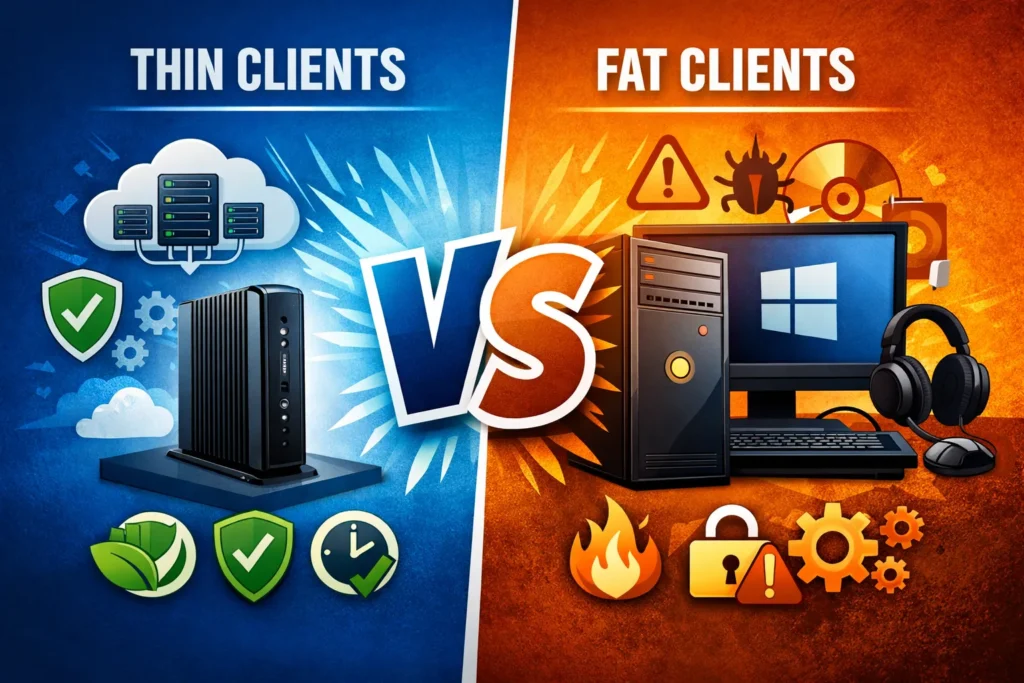
Traditional fat client models place compute, storage, and layered security directly on the endpoint. Thin client architectures reposition the endpoint as a controlled access layer connected to centralized infrastructure. Here is a practical comparison of thin client and fat client strategies to further explain this aspect.
When computing scales centrally, endpoint hardware no longer dictates user experience. That separation makes the extended lifecycle sustainable without sacrificing performance.
Operational Stability Is a Strategic Asset
Endpoint dependency affects more than budgeting. It influences operational continuity.
When supply is unstable, deployment schedules shift. When refreshes are delayed, support complexity increases. When hardware models vary by region, standardization suffers.
By stabilizing endpoint roles and centralizing workloads, organizations create a predictable operational baseline. Predictability improves security posture, support efficiency, and compliance reporting. Stability becomes a strategic advantage.
What This Means for IT Leaders in 2026
Before committing to aggressive refresh cycles during volatile supply periods, IT leaders should re-examine their architectural assumptions. Can existing assets be extended through software optimization? Can local hardware dependency be reduced? Can computing be centralized without degrading user experience? Can security improve while device complexity decreases?
Extending endpoint lifecycle is not about delaying decisions. It is about making better ones.
Extending Endpoint Lifecycle Is a Structural Advantage
Hardware volatility will continue. Component pricing will fluctuate. Supply chains will remain uneven.
Endpoint strategies built on frequent replacement and growing local resource requirements become increasingly fragile in that environment. Extending hardware life while modernizing the endpoint role is not a temporary workaround.
It is a long-term resilience strategy.
If you are evaluating how to stabilize your endpoint roadmap while markets recalibrate, we are always open to a focused strategic discussion.