5 Reasons Working with a Thin Client Vendor Pays Off (Even if You Could Buy Fat Clients)
February 5, 2026
Let’s be honest. If you walk into most organizations today and ask what their endpoint strategy is, the default answer is still usually a traditional PC or laptop — a fat client. A Windows box from a mainstream OEM. Familiar. Safe. Easy to justify. Procurement likes it. Users recognize it. And no one ever got fired for buying from a big hardware brand.
But “safe” doesn’t mean “smart.”
Over the past decade, the way work gets done has shifted. Applications live in the cloud. Desktops are virtualized. Identities are centralized. More compute happens in data centers or cloud environments rather than on the desk. If your users primarily access virtual desktops, SaaS apps, or browser-based tools, buying a high-powered local machine for every employee is increasingly inefficient.
You can keep buying fat clients. Plenty of organizations still do. But in many environments, the better move isn’t just “thin client vs fat client.” It’s choosing to work with a thin client vendor that understands end-user computing (EUC), VDI, and cloud workspaces — and supports you beyond the box.
Below are five reasons why that choice actually pays off in practice.
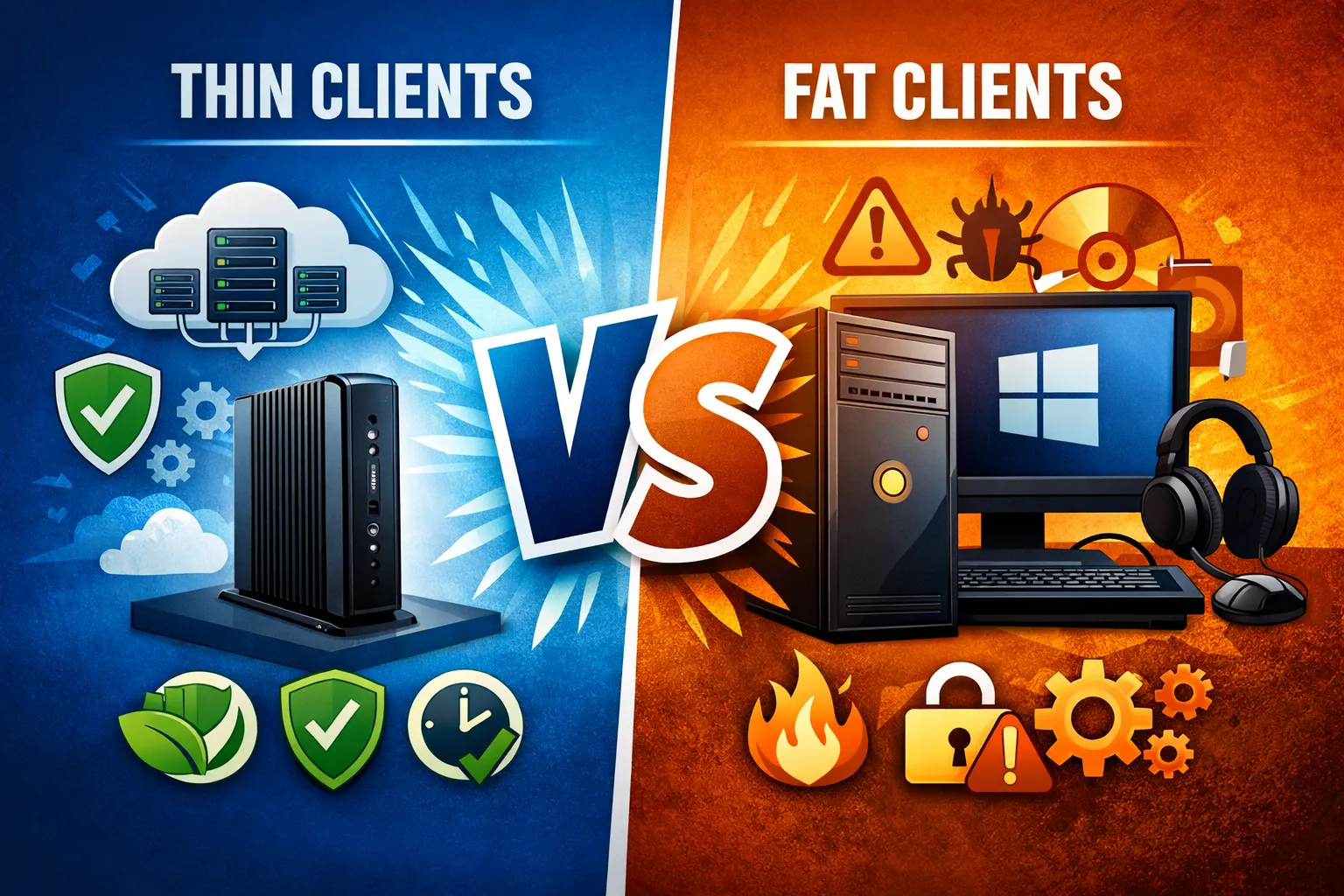
Table of Contents
ToggleAt a Glance
A strong thin client vendor doesn’t just sell endpoints. They deliver purpose-built, low-power hardware, longer standard warranties, OS and device management support, simpler replacement processes, and faster access to people who actually understand VDI and cloud desktops. This becomes especially important when organizations want to reduce Windows endpoint risk while lowering operational overhead.
1) Purpose-Built, Fanless Endpoints That Cut Energy Waste and Last Longer
Traditional desktops and laptops are designed for local compute. That means more power draw, more heat, and usually active cooling. Even if the user is mostly running a remote desktop session, the device still behaves like a full PC that needs constant care.
Thin clients are built for the world we actually live in now: VDI, DaaS, cloud desktops, and browser-first apps. They’re often fanless, low power, and designed to sit on desks for years without drama.
That “years” part matters. Thin client hardware tends to last longer because it has fewer moving parts. No spinning fans. Fewer failure points. Less dust-related performance decline. In large fleets, fewer mechanical failures is not a nice-to-have — it’s real operational savings.
For organizations that want a tangible example of this design philosophy in practice, the TCD 1 Series Thin Client PC is built around low power, fanless operation, and enterprise durability rather than raw local compute.
2) Longer Warranties That Match Enterprise Lifecycles
Buy a standard business PC and you’ll usually get a one-year warranty. Anything beyond that is an add-on — and often an expensive one.
With most thin client vendors, three- or five-year warranties are commonly included as standard. That’s not just a perk. It reflects how these devices are built and intended to be used.
Thin clients are not consumer gadgets meant to be refreshed every 24 months. They are enterprise endpoints designed to operate reliably in hospitals, schools, factories, contact centers, and corporate environments.
Because they have simpler internals and fewer moving parts, they tend to be more durable over time. That durability is a key reason vendors are willing to offer longer warranties in the first place.
From a financial perspective, this improves the total cost of ownership:
- Fewer out-of-warranty replacements
- More predictable refresh cycles
- Lower long-term hardware spend
- Reduced operational overhead for IT teams
3) Support That Extends Beyond Just the Hardware
This is where the difference between a thin client vendor and a traditional PC manufacturer becomes clear. A mainstream hardware vendor primarily sells you a device. Their involvement usually ends at basic hardware support.
A strong thin client vendor is typically embedded much deeper in your EUC environment. They support:
- The endpoint operating system
- The device management platform
- Integration with VDI and cloud desktop environments
- Compatibility with Citrix, Omnissa, Microsoft AVD, and Windows 365
That matters because endpoint issues in modern environments are rarely just “hardware problems.” They often involve display protocols, device management policies, USB redirection, identity flows, and cloud performance.
For teams that want a structured way to think through where thin clients fit in a modern EUC stack — from architecture to cost to operations — this guide maps the entire landscape in one place: The Ultimate Thin Client Guide for 2026 — a practical decision framework for modern EUC teams.
4) Faster, Simpler RMA and Device Replacement
Device failures are inevitable in any large organization. With traditional PCs, RMA processes can be slow and painful:
- Diagnose whether the issue is hardware or software
- Ship the device back
- wait for repair or replacement
- Reimage or redeploy the machine
- Deal with user downtime
Thin client vendors often handle this far more efficiently. Because devices are standardized and centrally managed, replacements are usually straightforward. Many vendors offer advanced replacement, where a new device arrives before the faulty one is even returned.
Since thin clients store little to no local user data, swapping devices is typically as simple as plugging in a new unit and enrolling it in management.
5) Faster Access to EUC Experts — Not Generic Hardware Support
One of the most underrated benefits of working with a thin client vendor is access to people who actually understand modern EUC environments.
If you call a mainstream PC manufacturer with a VDI or cloud desktop issue, you may end up explaining basic concepts like what a virtual desktop is or how display protocols work. Thin client vendors deal with these topics every day. Their support teams are typically far more familiar with:
- Remote display protocols
- Thin client operating systems
- Endpoint management platforms
- Peripheral behavior in VDI and DaaS
- Real-world EUC troubleshooting
When users can’t access their desktops, they don’t care whose fault it is — they just want to work. Having a vendor that understands your stack can dramatically improve those outcomes.
Conclusion: Endpoint Strategy Is Also a Security Decision
This isn’t just a hardware debate. It’s an endpoint strategy decision.
You can continue buying traditional fat clients. Many organizations will — sometimes out of habit, sometimes due to procurement preferences, sometimes because change feels risky.
But when you look at modern EUC realities — cloud desktops, hybrid work, rising energy costs, increasing management complexity, and growing security threats — the case for working with a dedicated thin client vendor becomes much stronger.
You get:
- Fanless, low-power devices that reduce energy waste
- Longer warranties aligned with enterprise lifecycles
- A vendor that supports you beyond just hardware
- Simpler RMA processes and faster replacements
- Direct access to EUC experts who understand your environment
Beyond that, thin client hardware is simply built to last longer. With far fewer moving parts than traditional PCs, these devices tend to operate reliably for years — which means fewer failures, fewer refresh cycles, and less electronic waste.
Now take this one step further.
If your “fat client” plan is really “Microsoft-based fat clients everywhere,” the conversation shifts from cost and efficiency to security.
Traditional Windows PCs significantly expand your attack surface:
- Local admin privileges
- Greater exposure to malware and ransomware
- More complex patching requirements
- Increased risk of data leakage
- A constantly evolving vulnerability landscape
At that point, the debate is no longer just about performance or price — it becomes a full-blown security discussion that many organizations underestimate until they face breaches, compliance issues, or ransomware incidents.
For organizations thinking seriously about endpoint risk, Microsoft itself frames this challenge as attack surface reduction — an increasingly central pillar of modern endpoint security.
Thin clients don’t eliminate every security risk, but they materially reduce it by shrinking the local attack surface, centralizing control, and keeping sensitive data and workloads off the endpoint.
If your goal is lower energy consumption, longer-lasting hardware, simpler management, stronger security, and fewer operational headaches, partnering with a true thin client vendor is the path that consistently delivers better outcomes.