IGEL Now & Next® 2026: What It Signals for Thin Clients and the Future of EUC
April 9th, 2026
Table of Contents
ToggleA Big Event, But the Real Story Is Bigger Than IGEL
At first glance, IGEL Now & Next 2026 appeared to be a standard vendor conference, marked by 23 announcements, new integrations, and expanded partnerships, with a notable emphasis on security and AI. But the real story goes beyond just product updates.
But if you read between the lines of the official press release, this event signals a critical shift: the industry is moving toward thin clients as the cornerstone of endpoint strategy.
It was about where the endpoint strategy as a whole is heading. And that direction strongly reinforces something we’ve been seeing across the industry: Thin clients are now the foundation of modern EUC.
The Shift Happening Right Now in EUC
There’s a growing disconnect in IT today.
On one side:
- More cloud adoption (AVD, Windows 365, Horizon)
- More distributed workforces
- More security pressure
On the other:
- Traditional endpoints are still complex
- Still vulnerable
- Still expensive to manage at scale
Events like IGEL Now & Next 2026 and Citrix UNITE 2026 highlight a clear industry priority: the need for endpoints to evolve from a weak point to a highly controlled layer within the IT stack.
It has to become the most controlled layer in the stack.
Security Is No Longer an Add-On
A big portion of IGEL’s announcements focused on:
- Contextual access
- Secure enclaves
- FIPS-certified operating systems
- Zero Trust alignment
The key point: These security features are not add-ons. Instead, they represent a new class of endpoint designed from the ground up for security.
They assume a fundamentally different type of endpoint, one that is:
- Locked down
- Minimal
- Centrally controlled
That’s exactly the design philosophy behind thin clients. Instead of trying to secure a full OS with dozens of variables, you start with something intentionally limited.
This adjustment, from securing complex OSs to using intentionally minimal endpoints, is a major takeaway. It reshapes how security is approached in EUC.
Cloud Workspaces Changed the Role of the Endpoint
Another clear takeaway from the event was how tightly everything is now aligned with:
- Azure Virtual Desktop
- Windows 365
- Omnissa Horizon
Once your workloads live in the cloud, the endpoint’s role shifts.
It’s no longer about power. It’s about:
- Stability
- Compatibility
- Predictability
This is where thin clients outperform traditional PCs.
By providing consistent, simplified endpoints at scale, thin clients deliver one of the top takeaways from the event: real operational benefits for IT teams managing distributed environments.
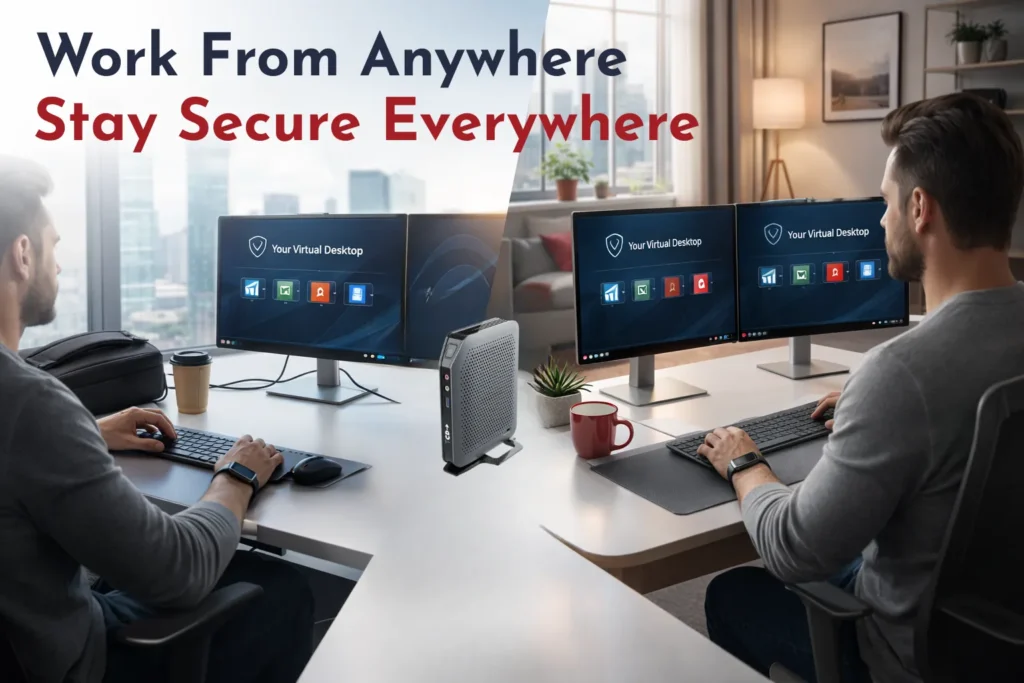
If you’ve seen how remote work environments have evolved over the past few years, this becomes even more obvious. We covered this in more detail in this breakdown of thin clients for remote work, where the same pattern shows up: simpler endpoints, stronger control, better outcomes.
The Real Problem: Complexity at the Edge
One thing that doesn’t get said enough in press releases: Most IT problems today aren’t caused by a lack of tools. They’re caused by too much complexity.
Multiple OS types. Different hardware profiles. Inconsistent configurations.
Every added variable increases:
- Support overhead
- Security risk
- Deployment friction
The key takeaway from IGEL Now & Next 2026: reducing endpoint complexity is central to the strategy, not just new features.
Thin clients play directly into that by:
- Standardizing endpoint hardware
- Running purpose-built operating systems
- Centralizing management across environments
This is operational relief for IT teams.
The Rise of Fit-for-Purpose Endpoints
Another subtle but important theme from the event is the move toward role-based endpoint design.
Not every user needs a full desktop anymore. In fact, most don’t.
Think about:
- Contact centers
- Healthcare workstations
- Retail or frontline environments
- Task-based roles
These users benefit more from:
- Fast login
- Reliable access
- Secure sessions
not from local compute power.
Thin clients are uniquely suited for this model because they enable IT to provide exactly the device each role requires, reducing unnecessary spending and complexity.
So, Where Does This Leave Thin Clients?
For a long time, thin clients were positioned as:
- Cost-saving alternatives
- VDI accessories
- Niche deployment options
That framing is outdated. Events like IGEL Now & Next 2026 make clear that thin clients are becoming the expected endpoint in secure, cloud-first environments.
Not because vendors say so, but because:
- Security models require it
- Cloud architectures enable it
- IT teams are demanding it
Final Word
Stripping away the branding and announcements, the single clear takeaway from IGEL Now & Next 2026 is this: The future of endpoints is defined by minimalism, control, and built-in security.
And when you look at what actually delivers that in practice…
Thin clients aren’t just part of the conversation anymore.
They’re leading it.
If you’re rethinking your endpoint strategy or exploring where thin clients fit into your environment, it can help to talk it through with someone who’s been in the trenches. Talk to an EUC Expert →